
May 2016
#bookhour not a deep insight, but it was interesting that this section also featured typographical changes in spacing.
#bookhour all plots move induced-death/freezing-ward. #lesscatchydelillo
#bookhour #q1 well, all plots move deathward, according to White Noise... I also found the dialogue more Ratner's Star than Point Omega.
That is, from the same people who told us that "going it alone" wasn't going to work.
If we leave the EU, I bet we'll see a rise of rhetoric that we have been "freed" from having to go along with Europe on OA.
Now the EU has a massive drive towards OA because of the Netherlands presidency, which clearly empowers the UK gov's stance on OA.
For years, some publishers have argued that OA in the UK wasn't viable because our small island was "going it alone".
Nervous about the EU referendum for many many reasons, but in the world of open access, there's an interesting irony...
Hmm. Had a tougher day today with lots of fatigue. But I did prepare a talk for the DARTS5 conference in Totnes on Thursday.
Beware the Trojan Horse: Elsevier’s repository pilot and our vision for IRs & Open Access http://intheopen.net/2016/05/beware-the-trojan-horse-elseviers-repository-pilot-and-our-vision-for-irs-open-access/
If you want to generate a webpage/CV w/ OA links to publications in repo (like https://www.martineve.com/c-v/), see here: https://github.com/MartinPaulEve/eprintsCV
Need to do a thorough sweep through to check that the underlying metadata is good in all instances, but basic check seems to be working!
Bit nervous that this update is forcing me on to Windows 10. Which I fear will destroy my bootloader & main Linux setup. Oh great.
So how can you know their expertise to assess when what/how you are assessing hasn't been decided? Or perhaps the consultation is a sham.
Great how TEF assessment panel members are to be appointed before the technical consultation closing date.
BIS Select Committee inquiry in 2013 rec. against NDAs from publishers & said would refer to competition committee. https://x.com/jenica26/status/733668935640461312
Good friends commissioned a portrait of our Guinea Pigs as a birthday present for me and it's brilliant!

The real problem with distant reading. http://zpr.io/KZ4b
Literary Criticism and the Small Press: A Symposium http://zpr.io/KZpH
All European Scientific Articles To Be Freely Accessible By 2020 http://zpr.io/Kq3y
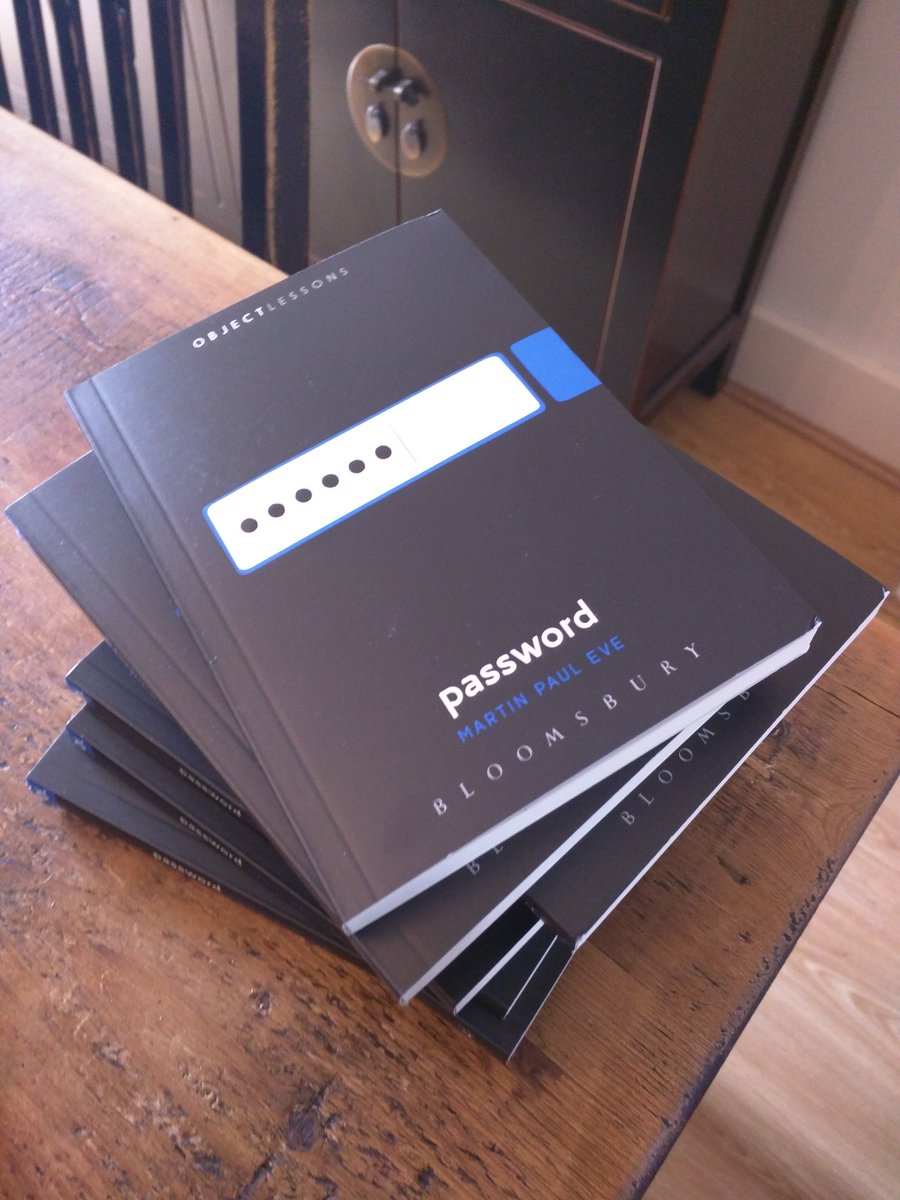
Hurrah! Advanced copies of my @objectsobjects book arrived today. They look very fine!
You know, "directing", meaning "giving feedback", "correcting", and "improving" what students do. Or, as we might call it: teaching.
The new GCSE drama specification in the UK says teachers are not to "direct" their students' performances, which only now make up 20% anyway
Come hear @Alison_Kinney, @badaude, @jeffreyjcohen and I speak on hoods, hotels, Earth, and passwords in July! http://pages.bloomsbury.com/bloomsburyinstitute/objects
Right, back to work. But no, latest Thunderbird has a bug blocking me from setting a security exception, so spend 1/2 an hour fixing.
Alternative Challenger Provider Institutions http://zpr.io/KHK6
Today is my thirtieth birthday and I have a piece out in the Times Higher on illness and academia https://www.timeshighereducation.com/features/coping-with-illness
"Also, competition and markets authority says there must be competition and markets in higher education. Over which we must have authority."
"Against almost all responses, we're damn well doing this anyway. And we can measure you even if it's dodgy. And there must be competition."
That the case across the board? Eh? Thought not.
Favourite part of the White Paper: the bit where it talks in approving terms of how it's doing what majority of responses said on one point.
Today's fun: rheumatology and vasculitis clinic.
Went to the book launch for Lesley Thompson's latest over at Kew Bookshop this evening. Spotted @DrBlacklock on the shelf!
TEF and tuition fees – myths and reality http://zpr.io/KUCe
Ah, and the old classic: employment rates to measure teaching quality. Because this won't cause grade inflation. Nope. Not a chance.
I also see that they haven't backed down on their truly dodgy teaching proxy measures. Such as employers choosing to sponsor some courses.
White Paper's mask really slips when it talks about drop outs of students "who were not capable of benefiting from higher education".
Also requested that the case study that neurology are writing on me be open access. #doingitright
Seen a few similar discussions in the UK recently. Varies hugely between institutions in contract language. https://x.com/LucyLambe/status/734771462205276160
This will explain why I have started to feel a lot better in recent weeks. Still a way to go but basically I'm healing well!
Turns out that my head is rewiring its vasculature and now has blood flowing through both carotids again. Amazing result.
Improving e-Journal Ingest (among other things) http://zpr.io/yWm8
Concluded that the human body is amazing - even if mine did go badly wrong...
This afternoon, neurology are getting their go at prodding me about. Such fun having many teams...
"Other university league tables focus on research scores. We don’t, because they are not important to students." - Guardian. They should be.
The market is free, yet everywhere it is in chains http://zpr.io/yBHr
Of course, very hard to choose who and what to fund. Many researchers fear for academic freedom & some publishers cry 'market'.
APCs are a symptom. Assumes that researchers will select based on some kind of price sensitivity. This makes volume crucial for publisher.
Problem is often funding infrastructure off temporary research grants. Gives no security to infrastructure. As @gbilder & @CameronNeylon say
Do "funders have a blind spot when it comes to funding infrastructure"? Maybe some do. https://svpow.com/2016/05/22/elseviers-increasing-control-over-scholarly-infrastructure-and-how-funders-should-fix-this/
Universities no longer for ever? http://zpr.io/yVGn
Tightening their grip http://zpr.io/yV6j
Laptops as pure aesthetics from a lost civilization.
Thinking about the way that preserved objects act as signposts in imagined dystopian futures to lost epistemic frames/use contexts.
Today I have been writing about metadata-like objects in Emily St. John Mandel's _Station Eleven_. Metadata-aesthetics book up to 40k words.
While Elsevier buys SSRN to achieve full-stack dominance, spending your time building open platforms in unis makes you neoliberal apparently
"All plots tend to move deathward" DeLillo wrote in _White Noise_. 2/3rds through _Zero K_ & it looks to move cryogenically resurrectionward
Apparently it's very common to have disturbed sleep patterns following a stroke. But really? 5am on a Saturday. Totally awake. Doh.
I expected later given huge reorganisation of UK HE research set out in White Paper https://x.com/c_d_hewson/status/733688333994430464
Music for a Friday https://soundcloud.com/sub-sonic-records/a-best-man-dead-people-power-somerville-wilson-dirty-disco-chug-mix?in=sub-sonic-records/sets/a-best-man-dead-people-power @ernestopriego @qui_oui @jon_fugler
on resistance to the HE White Paper http://zpr.io/ydiu
Website for Co-operative Leadership for Higher Education http://zpr.io/ydiK
The Open University blogs about joining @openlibhums http://www.open.ac.uk/blogs/the_orb/?p=1315
Morrison-Burke named inaugural Kit de Waal scholar @birkbeck_eh http://www.thebookseller.com/news/morrison-burke-named-inaugural-kit-de-waal-scholar-329829
Tonight, a great event on movement in the digital age at Kings College London at which I am speaking. Do come along! https://dhsociety.org/2016/04/29/speakers-announced-for-dhs-event-movement-in-the-digital-age/
Drop the plans to INCREASE tuition fees further and open more universities. - Petitions - https://petition.parliament.uk/petitions/130519
Pfizer Blocks The Use Of Its Drugs In Executions http://zpr.io/yJT2
And mags write the headings anyway in that piece that a certain publisher seems keen on. #notlinking
Nobody said publishers don't do things that should be paid for. We just said some of them are greedy. Like over a $1bn profit greedy.
Ten things you might have missed about the White Paper http://zpr.io/y54Q
The HE Bill in Parliament – Process and Procedure http://zpr.io/y54W
Tomorrow I will be speaking at King's College London on "Movement in the Digital Age". Hope some of you can make it! https://dhsociety.org/2016/04/29/speakers-announced-for-dhs-event-movement-in-the-digital-age/
Theoretical Breakthrough Made In Random Number Generation http://zpr.io/y5ZA
Tough choice this evening: read the deadly dull but dangerous White Paper or the exciting work of my Ph.D. students? Going to treat myself.
on the HE White Paper and academic practice http://zpr.io/ykcV
The A Priori University http://zpr.io/ykcv
Bath Spa University joins OLH LPS model https://about.openlibhums.org/2016/05/17/bath-spa-university-joins-olh-lps-model/ #greenlight4oa
Homogenization of universities by market.
Easiest solution: become more like existing institutions and target more conventional demographics. Not good.
Those specializing in P/T, mature students, for instance, saw huge drop-off in numbers.
Recent "reforms" to HE haven't resulted in more diverse "market". They've forced institutions that specialised to become more conventional.
It does have one mention of "lifelong learning".
The #HEWhitePaper is here, by the way: https://www.gov.uk/government/uploads/system/uploads/attachment_data/file/523396/bis-16-265-success-as-a-knowledge-economy.pdf
#HEWhitePaper does drop the FOI nonsense, though. cc @generalising
#HEWhitePaper says that relocation of QR to UKRI (the new single body) "is critical to achieving greater strategic coordination" #armslength
Jo Johnson has a lot of primary legislation to get through parliament for the HE White Paper plans. Is there time?
Tomorrow is grim HE White Paper day! Oh joy! And my stereo amplifier has just blown up! What a time to be alive.
But also warns that by 2001 the FBI and Scotland Yard may have stylometric profiles of all citizens. Who knows whether they do...
Now relaxing by reading the excellent 1982 book, The Computation of Style, which writes w great enthusiasm of the development of computers.
Did quite a bit of publishing tech dev stuff today, which was satisfying.
ZFS For Linux Finally Lands In Debian GNU/Linux Repos http://zpr.io/yFvN
This morning's fun: CT angio scans. On a Saturday AM! Checking what my useless blood vessels are up to. #SevenDayNHSisHereAlready
Differential fees need scrutiny, not sympathy http://zpr.io/yFNk
Particularly enjoyed @printjournalism's paper on c19 advertising and it's non-digitization at #bbkdigifutures. Wanted to hear more on this.
Stuart Hall’s Library - http://www.ccl.bbk.ac.uk/stuart-halls-library/
Hopes, fears and predictions for the coming White Paper http://zpr.io/y3RM
First really long work day today since getting out of hospital. And I didn't sleep well. Wish me luck!
Google Open-Sources SyntaxNet Natural-Language Understanding Library, Parsey McParseface Training Model http://zpr.io/ywDm
Job: Assistant professor in Digital Humanities and Information Cultures – University of Amsterdam http://zpr.io/ywDM
Also, the "stylo" package in R is great for quickly plotting basic stylometric analyses.
Basically, the frequency of words like "the" and "a" are different enough between sections of the novel to tell them apart computationally.
Stats + lit fact of the evening: classic delta of words that occur in all sections of Cloud Atlas are enough to differentiate the sections.
IBM developed a 'magic bullet' to combat viral infections - http://google.com/newsstand/s/CBIwpbmrqio
The Future of Storage http://zpr.io/yDwJ
Editors’ Choice: How Cultural Capital Works – Prizewinning Novels, Bestsellers, and the Time of Reading - http://feedproxy.google.com/~r/DigitalHumanitiesNow/~3/oI1TtzlBZsI/
Isn't everyone excited about the forthcoming HE Bill? Everyone? Anyone? #beafraid
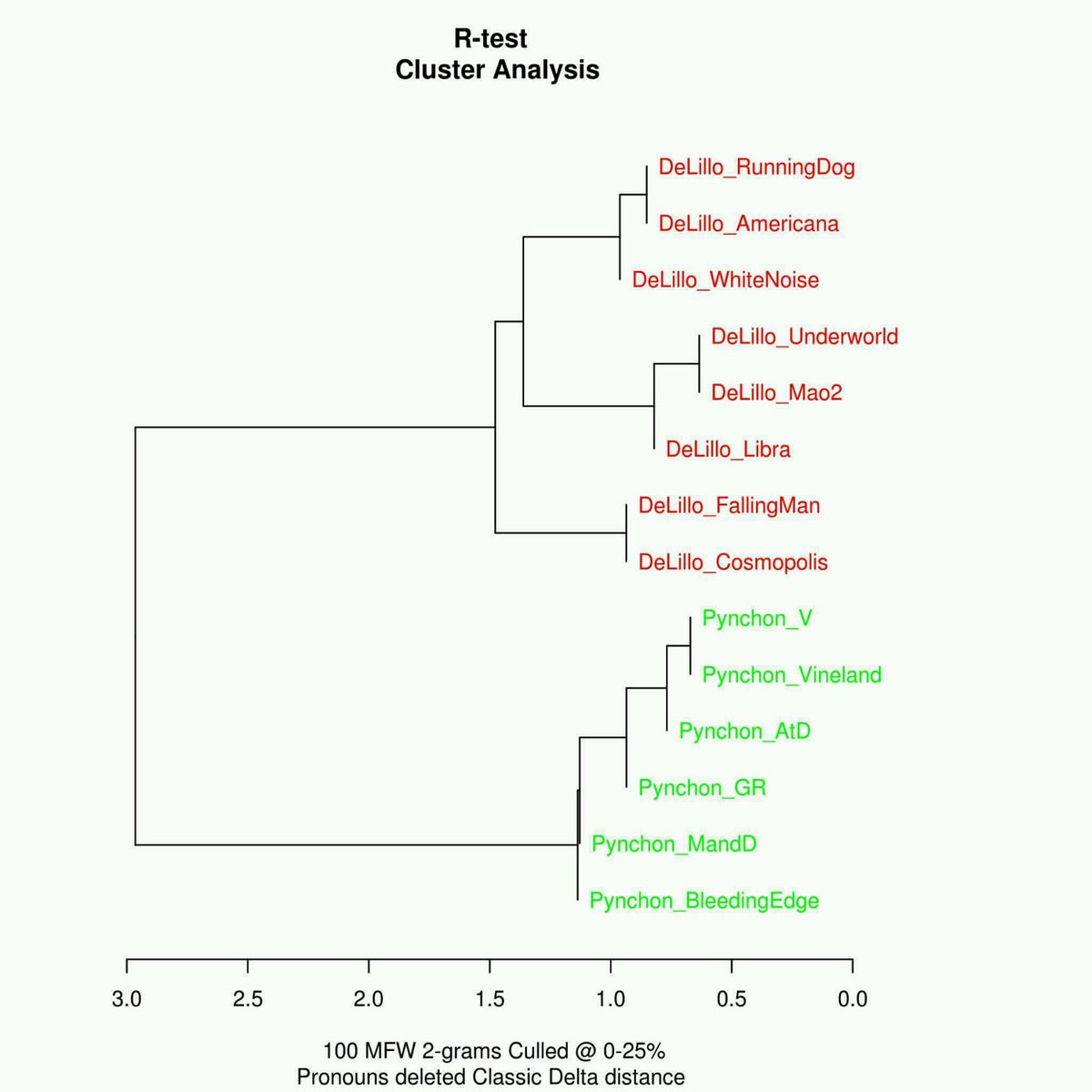
Turns out that simple z-scored manhattan distance of top 100 word pairs can tell DeLillo from Pynchon.
Talking Shop: Dr Harriet Earle http://zpr.io/y99U
Oh dear. Think I just read the most libertarian techno-fetishist piece ever. A Slashdot article about replacing government with computers.
Text Mining at an Institution with Lesser Financial Resources http://drewvandecreek.blogspot.fr/2016/05/text-mining-at-institution-with-lesser.html
More and more, the EU referendum is just so clearly Conservative party factional in-fighting dressed as a crucial democratic issue.
It's this kind of thinking that brings me back again and again to thinking about labour as core concern in education and open access.
Stuff on the commodity-form of monetarily free goods because of their interrelation with exchanged labour power is important.
Behind a paywall, but re-read + enjoyed Joss Winn's ‘Open Education and the Emancipation of Academic Labour’ <http://dx.doi.org/10.1080/17439884.2015.1015546>.
Debian Dropping Support For Older CPUs http://zpr.io/yhEy
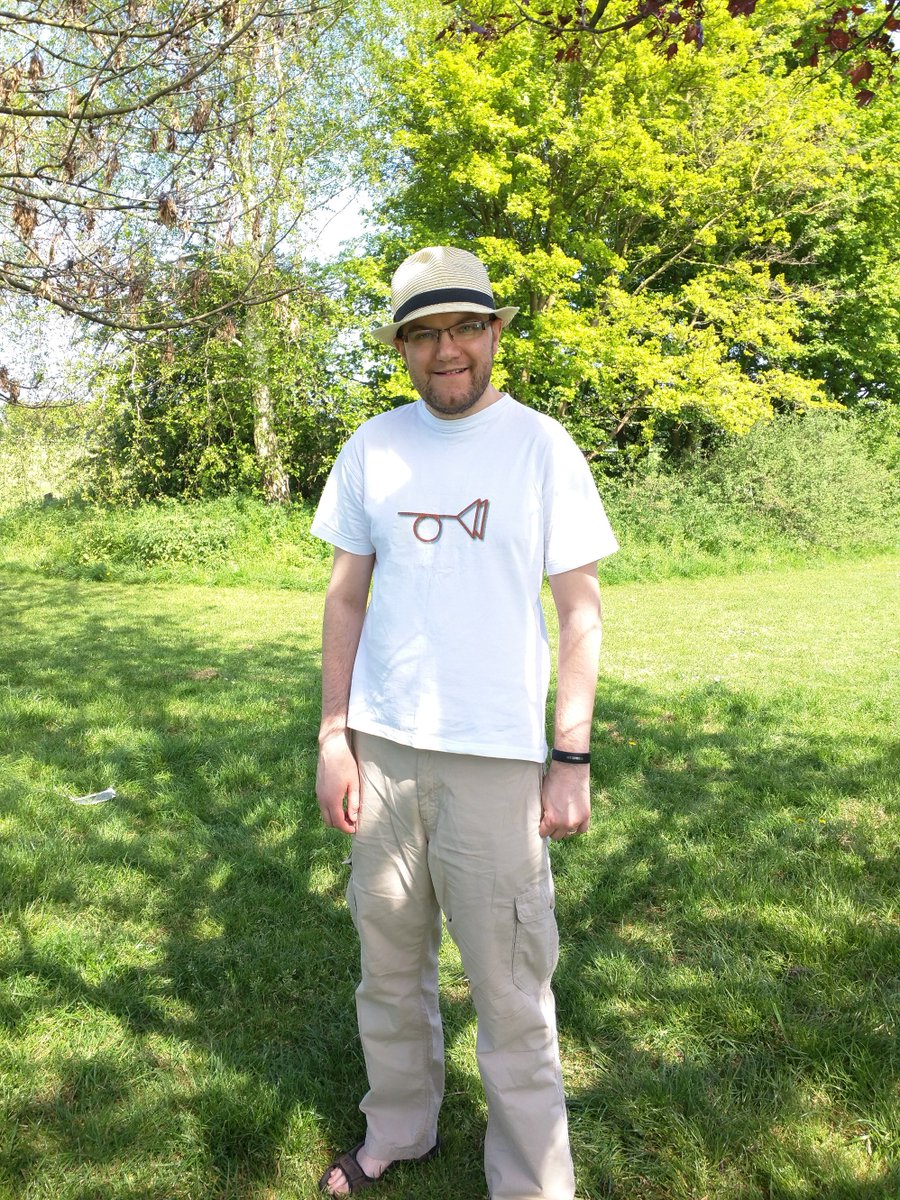
Never liked Radiohead's music, but I do like their style. Site called W.A.S.T.E and new album on Pynchon's birthday.
#PynchonInPublic #WASTE #awfulphoto
Kobo Customers Losing Books From Their Libraries After Software Upgrade http://zpr.io/ymhD
Hacker Magazine Phrack Returns After Four-year Hiatus http://zpr.io/ymh8
Walked amid bluebells.

Using social media to map scholarly literatures http://zpr.io/yMiU
Cellphones Do Not Cause Brain Cancer, Says 29-Year Study http://zpr.io/yMK2
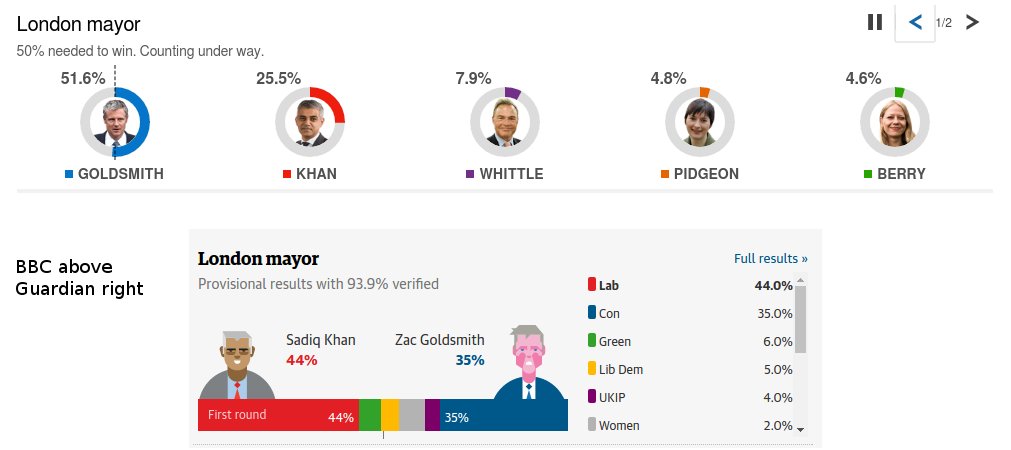
Seems BBC site is only taking one constituency into account: Bexley and Bromley: Goldsmith 51.6%, Khan 25.5%
BBC seems to be saying Goldsmith has won London mayoral election with over 50%. Guardian says count is 44% to Khan.
Mark Amerika, Mobile Phone Film, Immobilité: UK Premiere https://www.eventbrite.co.uk/e/mark-amerika-mobile-phone-film-immobilite-uk-premiere-tickets-24770080979
"It is 561, not a trillion trillion." https://x.com/reutersLjungg/status/723574054175780864
I took a hypothes.is marker to the LARB piece on DH https://via.hypothes.is/https://lareviewofbooks.org/article/neoliberal-tools-archives-political-history-digital-humanities/
When peer-review works constructively in my discipline (I mean 2,000 word generous reports from both readers) being an editor isn't so bad.
Signal or Noise? http://zpr.io/yX4b
Editors’ Choice: A Second Round-up of Responses to “The LA Neoliberal Tools (and Archives)” - http://feedproxy.google.com/~r/DigitalHumanitiesNow/~3/hxXAlzi7nh4/
We've got some intelligence. It's the best intelligence, I can assure you. There's no problem with my intelligence. https://x.com/brianbeutler/status/728240396128653312
Briefing Paper: Open Access Monographs http://zpr.io/yXDQ
Medical Equipment Crashes During Heart Procedure Because Of Antivirus Scan http://zpr.io/yXDW
And now I have it stuck in my head. https://x.com/JMarkOckerbloom/status/728204346266017793
And it's goodnight from him. Going out on this one. https://soundcloud.com/bedrock_rec/beddigi79-nick-warren-guy-mantzur-sad-robot-rich-lane-remix-preview @qui_oui @ernestopriego @jon_fugler
Aging and Bloated OpenSSL Is Purged of 2 High-Severity Bugs http://zpr.io/yNnE
Elsevier Complaint Shuts Down Sci-Hub Domain Name http://zpr.io/yaSm
Diabetes risk of common arthritis medicine glucocorticoid quantified for first time http://zpr.io/yYGn
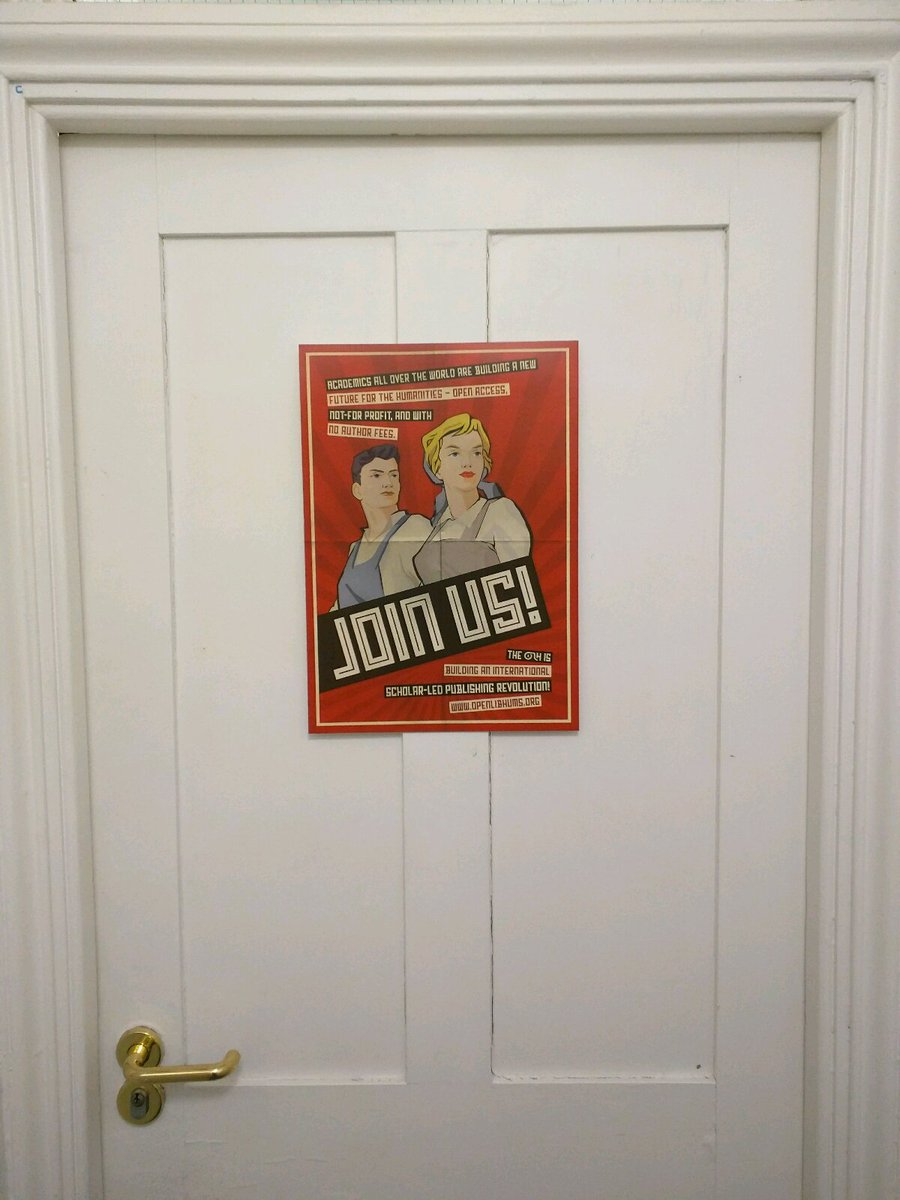
A great improvement to my office door with @openlibhums!
From 2007. Elsevier, Wiley hire PR guru to try to thwart OA. https://x.com/SciPubLab/status/727784509513543680
"You have died of peer review". Game over.

New article at @OrbitJournal on the different publishing phases of Pynchon's life in relation to counter-culture https://www.pynchon.net/articles/10.16995/orbit.188/
Using the death penalty to fight drug crimes violates international law, UN rights experts warn http://www.ohchr.org/EN/NewsEvents/Pages/DisplayNews.aspx?NewsID=16581&LangID=E
Ok, wasn't going to do that tweet sequence. But did today anyway. Felt good.
Nah, apparently they're neoliberal positivists.
I think of @samplereality's bots of conviction. I think of @elotroalex & @dennistenen's various projects. And hundreds more.
And I think - isn't that a good thing? To allow people access? To learn about histories of literature? To try to make tech help?
And then I think of DH projects to make work accessible to people who can't afford it. Of editions that trace complex publishing histories.
I think social theory and radical lit etc can empower people. I like it. But it's hardly liberating the world from within universities.
"Of course, it does resist commodification, though", you cry. Yes, except the tuition fees and the price of buying the research.
My fave line from the "critiquing the critique" piece is about how writing radical interpretations of lit hasn't brought down late capital.
Editors’ Choice: Round-up of Responses to “The LA Neoliberal Tools (and Archives)” - http://feedproxy.google.com/~r/DigitalHumanitiesNow/~3/YsA_xojjgeo/
Critiquing the Critique of Digital Humanities - http://text-patterns.thenewatlantis.com/2016/05/critiquing-critique-of-digital.html
Samsung Smart Home Flaws Let Hackers Pick Connected Doors From Anywhere In the World - http://rss.slashdot.org/~r/Slashdot/slashdot/~3/oejy3L1m4i8/samsung-smart-home-flaws-let-hackers-pick-connected-doors-from-anywhere-in-the-world < "smart" home
Genres and Writing in the Digital Age, 13th May at Birkbeck http://www.cncs.bbk.ac.uk/friday-13-may-2016-genres-and-writing-in-the-digital-age/
Had my first-year anniversary @birkbeck_eh on Sunday. Where did that time go?
Whenever the words "X is not art" appear in a Guardian headline, the byline will be Jonathan Jones.
Message in a Bottle http://zpr.io/yP6v
Are we seeing the rise of the Trump Academic? http://zpr.io/yUM4
Admittedly, 300 more to go, so not out of the woods yet.
Today I checked the metadata on 200 or so back content import articles for @openlibhums. Exciting project! More soon...
Knew most of the story from various sources, but greatly enjoyed this piece on Ramanujan by Stephen Wolfram. https://backchannel.com/who-was-ramanujan-83b4d5b05665#.jdn4d5tnq
The value of student loans http://zpr.io/AQDy