
Spoilers in this post

I have just read qntm’s excellent science fiction novel, There Is No Antimemetics Division. Those who have read the text will know that the novel focuses on the concept of “anti-memetics”, which consists of ideas and entities that are impossible to spread and sometimes even to perceive. In the novel, when people come within reach of such an entity, they simply forget they ever had the encounter. Attempts to document the existence of these “unknown” entities with anti-memetic properties leads to degradation of the media on which the account is stored. The anti-memetics division of the title refers to a secret agency dedicated to documenting, containing, and ultimately fighting these beings.
The text is a mixture of science fiction, body horror and, at its heart, a more conventional love story. The novel is very good at twisting you inside out with its surprises. It also draws close attention, I think, to the relationship between memory and thought. What is possible to think from a blank slate, as opposed to having a context predefined for you? How does your identity link to memory? Are you really yourself, if you can’t remember past incarnations of you?
Structurally, the novel is also interesting. It takes a disjointed form of stories working back and forth in time that are only woven together in the latter part of the novel. In a way, this is gesturing towards the memory fragmentation that drives the thematics. However, I did wonder whether this was slightly overdone as it does make for a more frustrating reading experience (not that reading should not, at times, be frustrating and difficult etc.)
I was also interested in notions of redaction in the novel. The text uses a redaction technique to signify areas where either the reader’s brain has been altered by the memory agents or the character cannot even, themselves, perceive what is happening. This reaches its most extreme in the text like this:
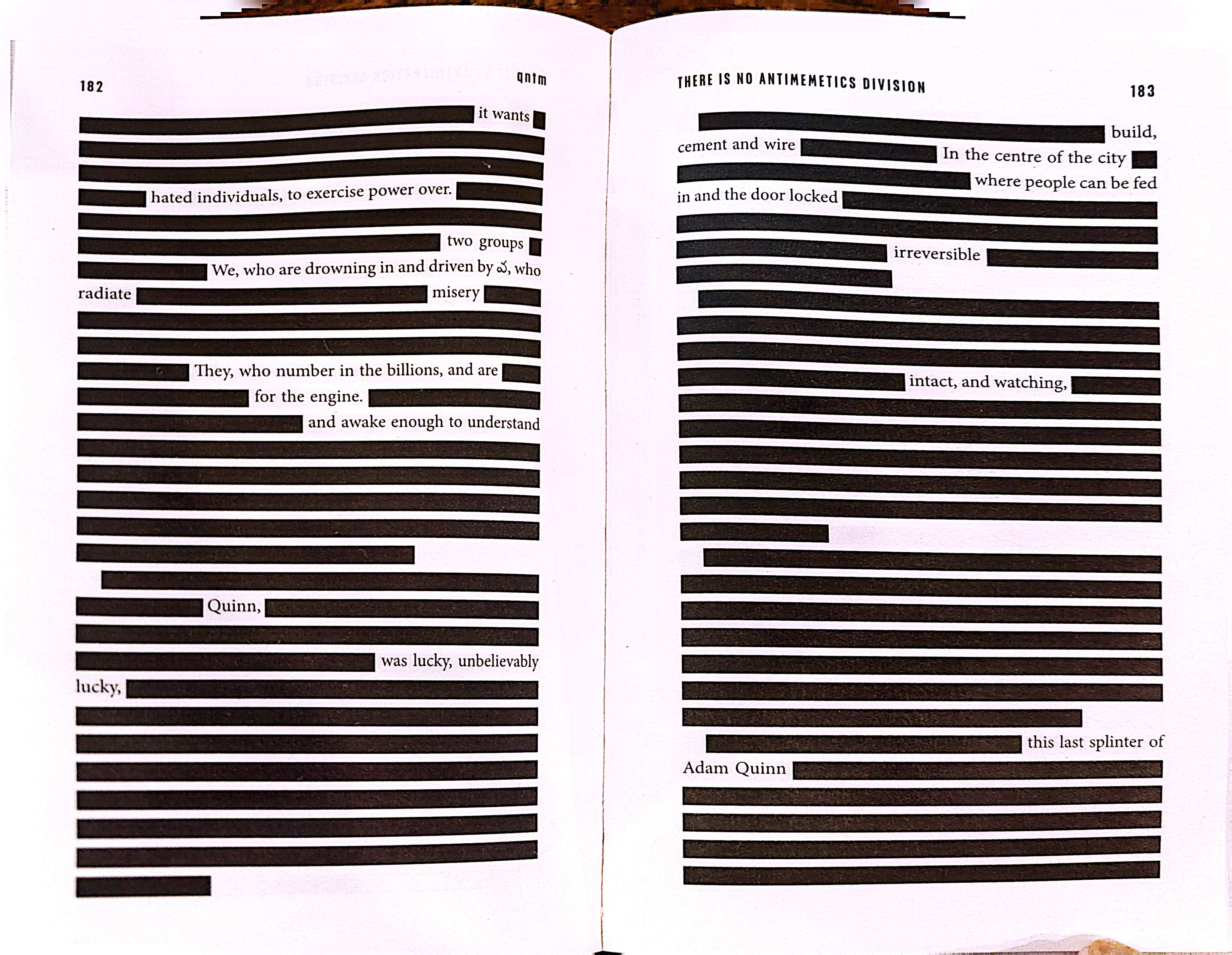
First, do not worry(!), most of the novel is not like this at all. This is the apex of the redaction technique. Second, I have written extensively about redaction in my Critique article, “Reading Redaction: Symptomatic Metadata, Erasure Poetry, and Mark Blacklock’s I’m Jack” (open access). There, I argued that we can understand these redaction techniques by thinking about the surrounding text as metadata that turn these “empty” spaces into signifying zones: “blank surfaces are, in fact, textured depths that can be read”. There Is No Antimemetics Division, however, complicates the taxonomy of blanks/redactions that I concocted. Using these to represent missing memories is a really interesting new avenue.
Overall, though, I suppose I just wanted to write this to say that this was a very enjoyable work of fiction. I did wonder, though, whether it was exhausting its concept before it was done telling the story. I also do not doubt that the high pace of the text probably makes it most suitable for Hollywood adaptation at some point in the future. How the textual features and structure that represent loss of memory can be replicated in a filmic medium remains to be seen.